



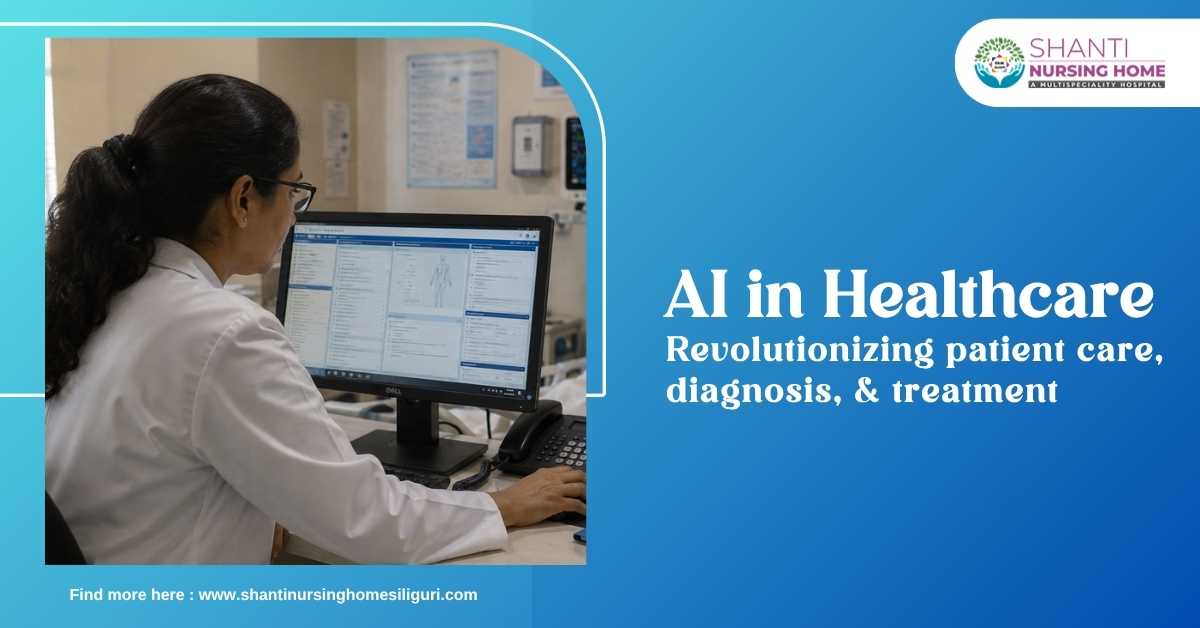

Now, AI is used in almost every field, and it is also used in healthcare. It helps doctors and healthcare professionals in their work and also supports patient care.
AI in Healthcare is changing the analysis of medical information, diagnosis support, treatment planning, and patient monitoring.
AI is becoming an important part of healthcare, analysing medical images to support personalised care. It helps doctors to analyse information and identify important details, and also helps interpret information, detect health issues, and make informed treatment decisions.
AI in Healthcare: Before and Now
|
Before: Traditional Healthcare |
Today: Technology-Supported Healthcare |
|
Doctors manually review medical data. |
Faster processing of medical information |
|
Doctors manually review medical data. |
Technology can help identify findings that need attention. |
|
Diagnosis may take more time |
Quicker screening and analysis |
|
Similar treatment approaches |
Care can depend on people's needs |
|
Check-ups at set intervals |
Regular and remote health monitoring |
|
Records managed manually |
Patient information organised digitally |
|
Limited comparison of data |
Large amounts of medical data can be compared |
|
Research depends more on manual review |
Technology helps researchers examine data |
|
Doctors handle many routine tasks |
Less time spent |
How Is AI Changing Patient Care?
Here are several ways AI is helping to improve the healthcare industry:
- Personalised treatment plans
- Quick access to patient records
- Support with diagnosis
- Spotting health problems earlier
- Regular patient monitoring
- Remote health monitoring
- Identifying possible health risks
- Medication and treatment reminders
- Virtual health support
- Quick responses to patient questions
- Less administrative work
- Better organisation of patient records
- Support with medical decisions
- Smoother hospital operations
- Better follow-up and post-treatment care
- Support for preventive care
- Better use of healthcare resources
- Help with chronic condition management
- Additional support for healthcare professionals
How Is AI Improving Medical Diagnosis?
AI helps doctors analyze medical data and also helps identify any health concerns.
- Analyzes medical images
- Reviews test results
- Finds unusual patterns
- possible abnormalities
- Helps detect diseases at an early stage
- Monitors changes over time
- Helps with early detection
- Supports clinical decisions
- Saves diagnostic time
- Helps prioritise high-risk cases
- Supports doctors during diagnosis
AI in Medical Imaging
AI helps you find those areas that need extra care or attention.
- X-rays
- CT scans
- MRI scans
- Ultrasound
- Mammograms
- Retinal images
- Pathology images
Early Detection of Diseases
AI helps to identify the signs and small changes at early stages.
- Detects small changes
- Supports screening
- Flags abnormalities
- Compares previous scans
- Tracks disease changes
- Supports early evaluation
AI in Cancer Detection
It helps doctors identify abnormalities that need expert care.
- Analyses the medical images
- Reviews and interprets pathology images
- Flags suspicious areas
- Supports cancer screening
- Compares images
- Assists specialists
AI in Eye Disease Detection
AI helps to look at photographs of the retina to find any eye problems.
- Retinal analysis
- Diabetic retinopathy screening
- Glaucoma screening
- AMD screening
- Retinal disease detection
- Tracks retinal changes
Analysing Laboratory and Patient Data
AI helps analyse health information to identify important patterns.
- Analyses lab results
- Reviews patient history
- Identifies data patterns
- Compares past results
- Tracks health changes
- Identifying potential risks
- concerning results
- Supports medical decisions
AI is used in diagnosis, but it does not replace doctors. Always consult your doctor before making any medical decision.
What Are the Benefits of AI in Healthcare?
Faster Data Analysis
AI makes the process faster by helping doctors analyse medical information, review test results, and identify important health concerns more efficiently.
Better Patient Monitoring
AI can analyse health data collected over time and help identify unusual changes. This can support continuous monitoring and alert healthcare professionals when further evaluation may be needed.
Reduced Healthcare Workload
AI makes routine tasks easier and faster, which helps healthcare professionals give more time and focus to their patients.
Support for Medical Research
Using AI, healthcare professionals can find information more easily; they do not need to spend a long time searching for information. Using AI, they can find relevant information within seconds, which saves them time on research.
More Efficient Healthcare
AI saves time and helps healthcare systems use resources more efficiently by supporting diagnosis, treatment, monitoring, and administrative tasks.
What Are the Limitations of AI in Healthcare?
Accuracy Issues
Sometimes AI does not give accurate answers or produces incorrect results, especially when your data is incomplete, poor-quality, or outside the system's training range.
The Need for Human Supervision
AI only helps to recognise patterns but does not completely understand the patients' emotions, circumstances, or their needs.
Costs of Implementation
The use of AI in hospitals and clinics can be costly in terms of technology, software, staff training, maintenance, and data infrastructure.
Regulatory and Ethical Concerns
The deployment of healthcare AI may be more challenging as it has to meet relevant requirements for safety, accountability, transparency, and responsible use.
Quality Data
AI works best when it is trained with accurate and reliable data. Incomplete, out-of-date, or inaccurate data can impact performance and reliability.
How Is AI Changing Medical Treatment?
Personalised Treatment Planning
AI is used to generate treatment approaches based on each patient's health conditions.
- Uses medical history
- Analyses patient data
- Considers individual health needs
- This helps to create personalised care plans
- Helps compare treatment options
AI in Precision Medicine
AI helps doctors understand complex patient data to make focused treatment recommendations.
- Analyses health data
- Studies genetic and clinical information
- Identifies treatment-related patterns
- Supports targeted treatment
- Helps personalise care
Predicting Treatment Response
AI helps estimate how a patient could respond to a treatment.
- Analyses previous treatment data
- Estimates possible treatment responses
- Identifies response patterns
- Supports treatment planning
- Helps to identify patients needing closer monitoring
- Predictions are not guaranteed
Monitoring Treatment Progress
AI helps to monitor how a patient's condition changes during their treatment and also helps to identify possible risks.
- Tracks health changes
- Compares results over time
- Monitors treatment response
- Flags unusual changes
- Supports follow-up decisions
- Helps assess treatment progress
AI in Drug Discovery and Development
AI helps researchers to analyze a lot of scientific and biological data during the development of drugs.
- Identifies potential drug candidates
- Analyses biological data
- Studies drug-target interactions
- Supports compound discovery
- Speeds up some research stages
- Helps analyse complex datasets
- New medicines still require extensive testing and clinical trials
What Should Patients Know About AI in Healthcare?
AI Supports Doctors, Not Replaces Them
AI is used in analyzing medical information, but doctors are still responsible for understanding the patient's condition and making clinical decisions.
AI Is Not Always 100% Accurate
AI also makes mistakes; it does not always give accurate results. That's why consulting with a healthcare professional becomes important.
AI Can Support Personalised Care
By analysing individual health information, AI can help doctors understand patient-specific patterns and support more personalised treatment and follow-up plans.
Doctors' recommendation is Still Matters
AI can help in identifying patterns or possible risks that doctors may not fully understand in a patient's symptoms, concerns, lifestyle, or personal issues.
What Is the Future Role of AI in Healthcare?
AI will become a stronger support tool for doctors, helping them by providing personalised healthcare.
- Early detection –Identifies the risk at an earlier stage.
- Personalised care – Supports customising treatment plans according to patients' conditions.
- Predictive healthcare –Helps to assess the possible health risks.
- Remote monitoring – Tracks patients using health data.
- Medical research –Supports drug discovery and disease research.
- Virtual assistance – Helps with basic queries and reminders.
- Clinical support –Provides additional insights for doctors.
- Preventive care –Supports earlier risk management.
- Human-AI partnership — Supports doctors; it doesn’t replace them.
FAQs
Can AI replace doctors in the future?
No, AI cannot fully replace doctors. This helps doctors with medical information, finding possible problems, and making better decisions. But doctors are still needed to understand patients, use their experience, and decide on the right treatment.
How is AI used in medical imaging?
AI can analyse X-rays, CT scans, MRI scans, retinal images, and other medical images to flag possible abnormalities.
Can AI detect diseases before symptoms appear?
In some screening applications, AI can identify early patterns or abnormalities before noticeable symptoms develop.
Can AI analyse medical test results and patient records?
Yes, AI can analyse multiple health data points and identify patterns that may support clinical decision-making.
Is AI safe and reliable for healthcare decisions?
AI can be useful when properly tested and monitored, but its results should be reviewed by qualified healthcare professionals.
At The End
AI in Healthcare is changing the way patient care, diagnosis, and treatment are approached. It can help doctors analyse medical information, support early detection, personalise treatment, and monitor patients more effectively.
At the same time, AI is a supporting tool, not a replacement for doctors. Human judgement, patient safety, and professional expertise remain important in every healthcare decision.
As AI continues to develop, understanding its benefits and limitations can help patients make more informed choices about their healthcare.
For professional medical care and guidance, Shanti Nursing Home can be a trusted option for patients needing appropriate healthcare support.